First Time on the Boards: A Newcomer's Companion to the Indoor Season
Your first indoor meet will almost certainly land on a Sunday in January. You will walk into an arena that smells of rubber and deep heat, hear a gun crack somewhere under the roof, and notice that four separate competitions are happening at once and none of them appear to be in the order printed on the programme. Then you will run 60 metres, and you will be back in your tracksuit before you have properly worked out what happened.
That is normal. It is also, once you know the routine, one of the best things about being in a club through the winter. What follows is the briefing most coaches would give you if they had twenty spare minutes and a mug of tea in their hand.
Indoors is a different sport wearing the same rules
Summer athletics is about weather, patience and standing in a field. Indoors is about noise, precision and very small margins. A 200-metre indoor track crams four bends into one lap, so the corners are tight, the straights are brief, and a 200 feels like it is being played at double speed. The 60 exists simply because there is nowhere sensible to run a 100. Field events often take place in the middle of the infield, which means a long jumper may well land a few metres from where you are crouched, tying your spikes.
The season is short — typically January to mid-March — and the fixture list is thinner than the summer one, so entries close earlier than you expect. Missing a deadline by two days is the most common rookie error of the entire winter.
Finding a first fixture that suits you
Open graded meetings are the friendliest entry point. You enter yourself, you pick a couple of events, you get a time, and nobody minds whether you are chasing a championship standard or simply trying not to trip. County and regional indoor championships are wonderful but often ask for entry standards or a recent performance, so check before you tap the button. Some indoor leagues also run 4x200m relays, which make a lovely first taste of racing indoors — you run one leg, the nerves are shared, and if it all goes wrong there are three other people to blame.
Age groups for the indoor season are worked out from your date of birth and the start of the season, and the detail differs slightly between the home countries. Your team manager knows. It is not worth guessing, and it is definitely not worth arguing about on a group chat at 11pm.
The kit question, answered honestly
Borrowed spikes are absolutely fine. Cross-country spikes are not — they are a different tool for a different job, and a 200-metre board track will punish you for wearing them. Ask the club kit cupboard, label whatever you borrow, and give it back clean (or at least drier than you found it).
A few practical notes that experienced athletes take for granted:
- Check the pin length. Several indoor venues specify shorter pins and officials may check at the call room.
- Carry your spikes in your hand once you are inside and walk around in trainers. Nobody wants a spike mark in a corridor.
- Bring layers. Arenas are freezing when you are sitting and baking when you are racing, and you will be both inside ninety minutes.
- Pack two pairs of socks, a spare top, a towel, and a plastic bag for anything wet.
- Water, snacks, safety pins, a bit of tape, and a named kit bag that is easy to spot in a pile of forty identical black ones.
The warm-up area is a shared kitchen
At the bigger arenas — Sheffield, Lee Valley, Birmingham, Glasgow — the warm-up space is generous but not infinite, and on a busy Sunday it gets crowded. The etiquette is simple: jog on the outside, keep your bag against the wall rather than in the middle of the floor, do not claim three mats for a stretching routine, and keep half an ear open for announcements.
Say hello to people. Indoor meets are small enough that you see the same faces from October to March, and by February the warm-up room feels more like a clubhouse than a queue.
Call room is the bit that catches everyone out
Somewhere in the timetable is a reporting time, and it is not a suggestion. You will be called, often over a slightly distorted PA, and you need to be ready — spikes in hand, number on, no headphones you cannot hear through. Officials check your bib, your kit and sometimes your pins, then walk you to the track. It feels unnervingly like being escorted into an exam.
Do the boring arithmetic before the day: work backwards from your race time, allow for a proper warm-up, and add ten minutes because everything indoors takes longer than you think. Clubs lose more performances to a rushed call room than to bad training.
Sixty metres: a very short race with a very long lesson
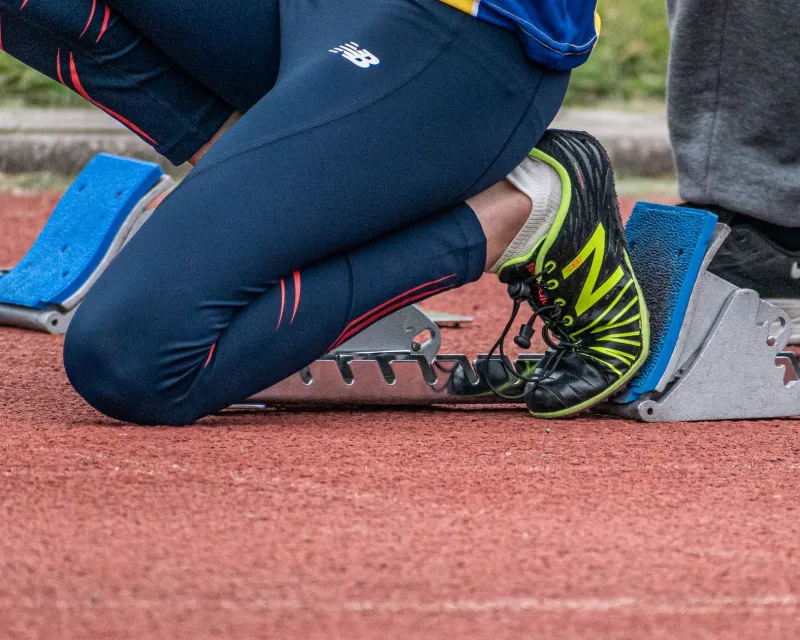
Most club athletes run a 60 in somewhere between eight and nine seconds. That means the start is effectively the entire race. There is no time to build into it, no chance to find a rhythm, and no opportunity to fix a poor first three steps. Some meets use blocks, some use standing starts, and either way you will likely get one or two runs for your entry fee.
Expect to feel like you have only just accelerated when you cross the line. Expect the noise under the roof to be startling. And expect the tight bend on the 200 to feel like something you should have trained for specifically — because you should have.
Afterwards: three things worth remembering
Write down your times, but also write down what felt wrong. Was the first step late? Did you drift out of the lane on the bend? Did you tie up at 45 metres? Times in January are a starting point, not a verdict. Indoor personal bests and outdoor personal bests are different currencies and should never be exchanged at face value.
Then go and watch a field event, cheer somebody from another club, buy a tea, and get home before it snows. The winter indoors is short, sociable and quietly brilliant. It will not make you a champion by March. It will make you a better, calmer athlete by April, and that is worth far more.