Dark Nights, Bright Habits: Why November Club Nights Deserve More Credit
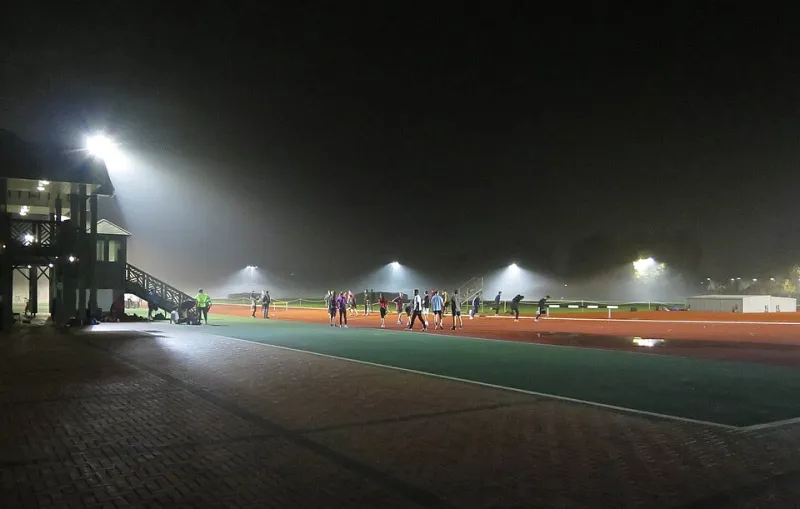
Photo: Hugh Venables , CC BY-SA 2.0, via Wikimedia Commons
November gets a bad press in athletics. The track season has packed up, the cross-country calendar is just finding its feet, and by half four the floodlights are doing all the heavy lifting. It is easy to call this the off-season. It is harder to explain why so many club coaches quietly love it.
At Athleticos, we have spent the past couple of weeks asking coaches and athletes about the winter window. The answer was consistent: the sessions that look least glamorous on paper are often the ones that hold a club together. Dark nights, muddy corners and borrowed sports halls are not a pause in the programme. They are the programme.
The calendar lies
A quiet race calendar does not mean a quiet club. It means a different kind of club. The summer asks athletes to sharpen up and perform. November asks them to turn up, build a base and remember why they joined in the first place.
That is not always an easy sell. One coach in the Midlands told us turnout can dip when the clocks change, especially among younger athletes who relied on a parent for a lift or who found their confidence in a summer league fixture. The clubs that keep people moving through winter tend to do the boring things well: clear messages, lifts sorted early, a plan for the session posted before anyone has to ask, and a warm room to gather in afterwards.
It sounds simple. It rarely is. But the coaches who get it right say the reward is a group that arrives in spring already knowing how to train together.
The hall, the hut and the humble cone
Not every club has an indoor track. Most do not. What they have is a sports hall, a school gym, a village hall or a patch of tarmac that can be made to work with enough cones and imagination.
One sprint coach we spoke to runs weekly drill sessions down a leisure-centre hall, using wall bars for mobility, markers for stride patterns and a couple of relay batons for changeovers that do not need a full track. A throws coach uses medicine balls and light implements to keep technique ticking over without needing a cage. An endurance group meets at a country park with head torches and a route that is checked in daylight before it is run in the dark.
None of this is revolutionary. That is the point. Indoor-hall improvisation is grassroots athletics at its most practical. It keeps athletes close to their coaches, gives feedback in small groups and turns a cold Tuesday into something that feels like a club night rather than a chore.
The best winter sessions also leave room for fun. Relays, team circuits, handicap races and the occasional ridiculous warm-up game are not distractions from serious training. They are how clubs keep newcomers in the room long enough to become regulars.
Turnout is a habit, not a miracle
The athletes who train through November are not morally superior. They have a habit, a lift and a reason to be there. Clubs can build all three.
Habit comes from routine: same night, same meeting point, same friendly face on the door. Lifts come from a parent rota or a minibus that is booked before the first cold snap. Reason comes from giving winter a purpose — a target race, a technical goal, a strength block, or simply the promise that the group will be there.
One athlete described her winter club night as the thing that stopped her drifting away from the sport. She was not chasing a championship. She was chasing the feeling of being part of something when the results pages were empty. That is worth more than a session plan can measure.
What shows up in summer
Coaches talk about summer performances as if they appear in June. They do not. They are built in the unglamorous months, in the strength work that never makes the results sheet, in the drills that feel repetitive until they suddenly click, and in the resilience of turning up when it is cold and dark.
That does not mean winter should be a grind. It means it should be intentional. The clubs getting it right are the ones treating November as a real part of the season, not a holding pen.
So no, the off-season is not a myth because athletes should train relentlessly. It is a myth because clubs cannot switch off and expect the summer to take care of itself. The floodlit sessions, the muddy shoes and the borrowed halls are where the habits live. Give them a bit more credit.